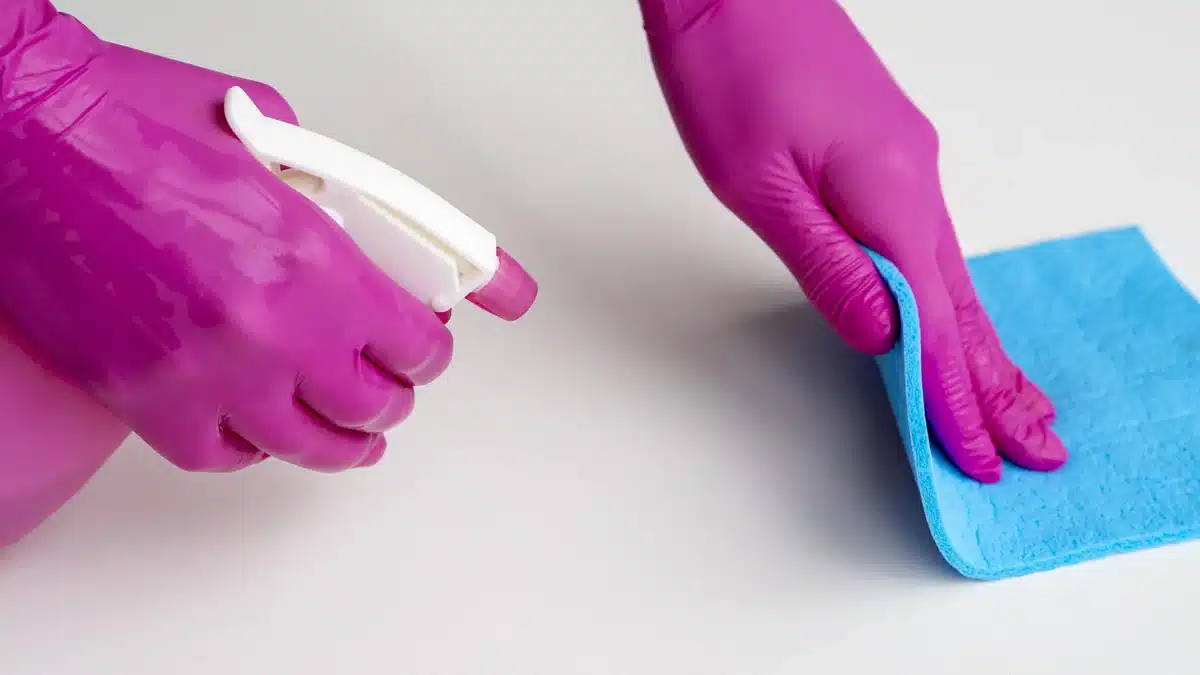
Disinfectant contact time is the period a treated surface must remain wet for the product to work against the organism specified on its label. The required time depends on the product and labeled use. It is not a universal number, and it is not automatically the same as drying time or permission to reopen an area.
For a facility manager, the practical question is whether the written procedure matches the actual product, surface and intended use. A quick spray followed by immediate wiping should not be treated as evidence of completed disinfection.
Where do you find the correct contact time?
Read the product's Directions for Use and match the stated organism, surface and application method. EPA guidance on registered disinfectants explains that the surface must stay visibly wet throughout the labeled contact time; additional application may be needed if it dries early.
Record the product identity and EPA registration number with the applicable instructions. Do not transfer a dwell time from another product or from a label claim for a different use. A generic instruction such as “disinfect for a few minutes” is not specific enough for a work procedure.
Contact time, cleaning and drying are different steps
| Term | What it means for the work plan |
|---|---|
| Cleaning | Removing dirt and organic material as required before disinfection |
| Contact time | Maintaining the labeled wet exposure for the intended disinfection use |
| Drying | The treated surface losing moisture after application |
| Reopening | Returning the area to use after applicable label and site requirements are satisfied |
EPA distinguishes cleaning, sanitizing and disinfecting. The terms describe different processes and claims. A surface that looks clean has not, by appearance alone, demonstrated a disinfection outcome.
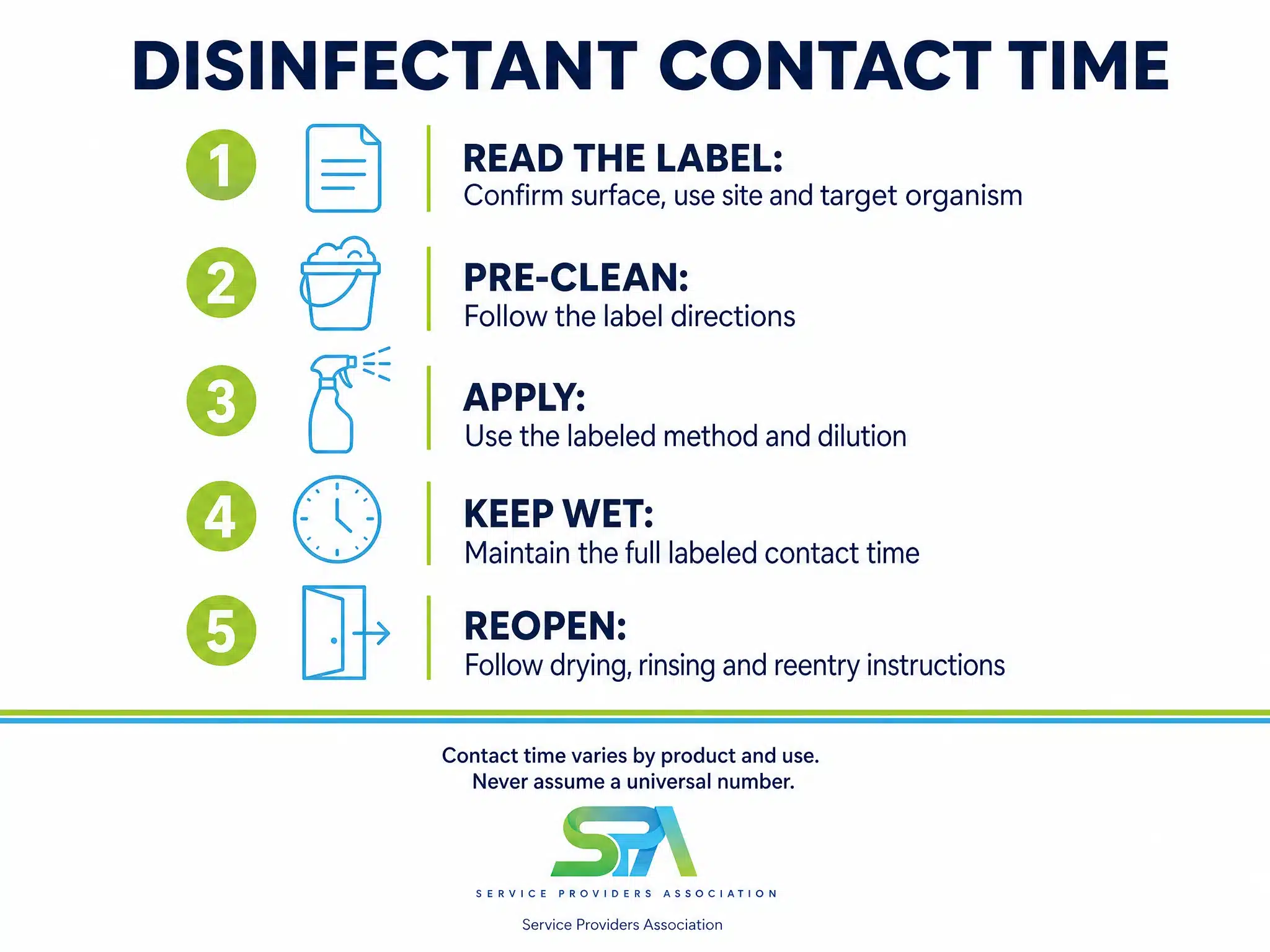
A five-step verification process
1. Confirm the intended surface and use
Check that the product directions cover the material and setting. Electronics, soft materials and food-contact surfaces can have different restrictions. Do not assume a product suitable for one desk surface is suitable for every object in the room.
2. Follow the preparation instructions
Identify whether and how pre-cleaning is required. If the product needs dilution, use the labeled instructions. Never improvise a stronger mixture to shorten a task or combine products to create an unverified process.
3. Use the approved application method
Specify whether the task uses a wipe, liquid or another labeled method. A routine spray instruction does not automatically authorize fogging or a different delivery system. Match equipment and protective measures to the instructions and site requirements.
4. Maintain the full wet contact period
Assign enough time to complete the process. The worker should be able to keep the surface wet as directed without wiping it dry early simply to finish the route. Escalate a procedure that cannot be followed within the available access window.
5. Check the instructions before returning the area to use
Follow any applicable rinsing, ventilation, drying and reentry directions. Completing the contact period does not cancel the rest of the label. CDC facility guidance also addresses product compatibility, protective equipment and avoiding chemical mixing.
What should your cleaning scope document?
The scope should identify the surfaces, purpose, product instructions, responsible staff and access arrangements. Where disinfection is required, confirm how it fits into commercial cleaning work without treating every routine wipe as a disinfecting task.
When discussing disinfecting services, ask for an explanation of the process and its boundaries. Do not substitute broad phrases such as “germ-free building” for a specific, verifiable procedure. No routine service can promise that a surface remains free of contamination after people use it again.
Disinfectant contact time FAQs
Is ten minutes the correct time for every disinfectant?
No. Use the time stated for the relevant product and labeled use. A number printed in an example, on another product or for a different organism is not a substitute for those directions.
Can staff wipe the surface dry to reopen a room sooner?
Not if doing so interrupts the required contact period. Follow the product instructions for what happens after that period, including any rinsing or drying requirements.
Is a safety data sheet enough to write the procedure?
Use the product label for approved uses and directions, alongside the safety data sheet for hazard information and protective measures. The work plan needs both the intended process and the relevant precautions.
How can I discuss a disinfection scope with SPA?
Tell Service Providers Association about the property, surfaces and service objective. Call 515-619-6430 or contact the team to discuss the requirements without assuming a particular product or health outcome.